
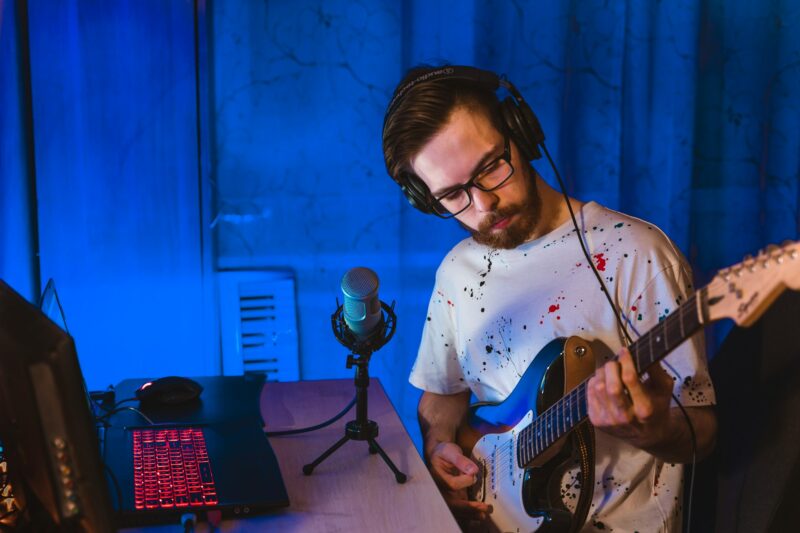
Across streaming platforms, bedroom producers and independent artists are racking up millions of plays because of sonic imperfection!. In a landscape increasingly saturated with AI generated music and hyper compressed major label releases, listeners are hungry for something that feels alive. Authenticity has become the new competitive advantage; it sounds like a breath before a vocal take. The slight wobble in a guitar string that wasn’t quite tuned. It sounds, in other words, like a real human made it.
The Tyranny of the Perfect Mix (And Why Listeners Are Over It)
For decades, the industry standard was clinical precision. Records were tuned, timed, and treated until every rough edge was sanded off. Auto-Tune corrected the pitch. Quantization locked every beat into a grid. Limiters pushed loudness to the absolute ceiling. The result was music that was technically flawless and emotionally distant.
Platforms like Spotify have already dismantled the “loudness war” that drove over-compression. But something deeper is shifting. Listeners—especially younger ones raised on lo-fi YouTube streams, cassette revivals, and TikTok voice-memo demos—have recalibrated their ears to prefer texture over perfection.
Studies have long documented that slight pitch and timing variations in vocals create emotional resonance that pitch-perfect recordings simply cannot replicate. The “human error” is actually the emotional signal.
What “Authentic Imperfection” Actually Means
Let’s be precise here, because this isn’t a call to record carelessly.
Authentic imperfection is intentional texture, the conscious choice to preserve the details that reveal a human hand at work. It’s the room sound left in a vocal. The pick scrape before a chord. The slight drag in a singer’s timing that mirrors how we actually feel when we’re sad, uncertain, or in love.
This is distinct from low production value. Artists like Phoebe Bridgers, Rex Orange County, and the early recordings of Billie Eilish (famously recorded in her childhood bedroom) demonstrate that you can have high craft alongside raw feel. The goal isn’t to sound poor — it’s to sound present.
For rising artists navigating their sound, this is liberating. You don’t need a $500-per-hour studio to compete. You need intention, taste, and the courage not to over-produce.
Why Indie Artists Have the Structural Advantage
Major labels are, by nature, risk-averse institutions. They invest heavily in recording infrastructure and expect returns that justify pristine, committee-approved production. That institutional pressure is precisely what smooths the life out of a recording.
Independent artists have no such pressure. No A&R rep asking to tighten the vocals. No label mandate to match a trending sound. This is the freedom that has always defined indie music and in 2026, it’s finally being rewarded commercially at scale.
And it’s not just about sound. As we covered in Fan Owned Royalties: When Your Listeners Become Your Label, the relationship between indie artists and their audiences is fundamentally different from the top-down broadcast model of legacy labels. Fans who feel they know an artist — who can hear the artist’s humanity in the recording — are the fans who buy, share, and invest. Authentic sound is part of authentic connection.
The Streaming Data Is Speaking
Independent music’s market share has been climbing steadily. In 2026, independent and self-released music has continued to outpace major-label growth in terms of new release volume and per-release streaming engagement.
More telling is the genre data. Lo-fi hip-hop, folk-influenced indie pop, bedroom pop, and acoustic singer-songwriter content — all genres that embrace raw sonic texture — consistently over-index on playlist saves and repeat listens compared to heavily processed mainstream pop.
On TikTok and Instagram Reels, the demo-quality recording often performs better than the polished single. Viewers respond to the feeling of discovery that they’re hearing something before it becomes a product.
How Artists Are Weaponizing Imperfection
1. Leaving Space in the Mix
Over-production fills every sonic space. Intentional production knows when silence and sparseness communicate more than another layer of synth. Think of the hollow, breathy quality of artists like Noah Kahan or Lizzy McAlpine.
2. Preserving Vocal Humanity
The most emotionally affecting vocals are almost never pitch-perfect. Microvariations in pitch, the catch in a breath, the slight roughness on a high note—these are the details that make a listener feel seen. Tuning lightly (or not at all) is a deliberate artistic choice, not a technical failure.
3. Embracing Room Sound
Recording in non-neutral spaces like a tiled bathroom, a wooden cabin, or a cluttered bedroom imprints a sonic identity onto a recording that no reverb plugin can fully replicate. That environmental authenticity is increasingly prized.
4. Keeping the First Take (When It’s the Best Take)
The first take often contains emotional truth that disappears after repetition. Artists who trust their instincts and resist the urge to endlessly re-record often capture something irreplaceable.
5. Analog and Vintage Gear (Real or Emulated)
The warmth of tape saturation, the hiss of a vinyl surface, the harmonic distortion of a tube amplifier — these are sonic imperfections that audiophiles and casual listeners alike associate with authenticity and warmth. You don’t need vintage hardware; plugins like Izotope Vinyl or Waves Abbey Road deliver these textures accessibly.
The AI Music Contrast Effect
The rise of AI-generated music has, paradoxically, supercharged the value of human imperfection. When unlimited amounts of technically flawless, perfectly structured music can be generated in seconds, the human fingerprint on a recording becomes a rare commodity.
We touched on this dynamic in our recent piece on How AI is Revolutionizing Music for Indie Artists: Finding Your Super Fans — AI can help with discovery and marketing, but it cannot replicate the lived-experience quality that makes an artist’s output uniquely theirs. And our breakdown of Prompt Engineering for Music Producers: The New Beatmaking Skill shows that even producers using AI tools strategically are using them to serve their human vision, not replace it.
The contrast effect is real: the more perfect AI music sounds, the more imperfect human music resonates. Listeners are developing an intuitive ability to sense when something was made by a machine and increasingly, they’re choosing human.
Building Your Sonic Identity Around Texture
For independent artists, this is both a philosophical and practical conversation. Here’s how to think about building a sound that leverages authentic texture:
Start with your natural environment. Don’t immediately rent a neutral recording space. Document what your room sounds like. Some of the most distinctive indie records were shaped by their recording environments.
Develop a relationship with restraint. Resist the impulse to layer and fix. Ask, with every production decision: does this addition serve the emotion, or am I covering up the truth?
Study artists who do this well. Listen closely to the production choices in records by Big Thief, Julien Baker, Alex G, or early Taylor Swift — artists who understood that texture was part of their story.
Trust your instincts over industry standards. The A&R checklist of 2010 is irrelevant to the streaming landscape of 2026. What matters is whether a listener feels something. If you need a reminder of why formulaic branding backfires, revisit our breakdown of the 7 branding mistakes killing indie musicians’ chances of getting signed.
The New Standard Isn’t Lower — It’s Different
To be clear: embracing authentic imperfection doesn’t mean accepting mediocrity. The artists winning with raw sound are still skilled. Their songs are still well-written. Their performances are still emotionally intelligent.
The standard has shifted, not lowered. What’s required now is not technical perfection, but emotional precision, the ability to capture and communicate genuine feeling, and the wisdom to know when the “imperfect” take is actually the perfect one.
Listeners have always known this. The tear in the voice. The drag of a tempo. The room is creeping into a recording. These are not failures. They are the evidence that a human being stood in front of a microphone and meant every word.
In 2026, that evidence is worth more than ever.